Interior Design AI: Why It Cannot Replace a Designer
Interior design AI can generate renders but can't save your renovation when walls open up. Here's why it still needs a real human in Boston and New England.
MY TWO CENTS
Erica Fossati
7 min read
I read this article recently and it got me thinking.
The author, Matt Shumer is a high-profile entrepreneur and the co-founder/CEO of OthersideAI, a company that builds tools to automate communication. He’s an insider in the LLM (Large Language Model) world. He isn't just a spectator, he builds the very engines that are changing how we write and work.
It’s clear that the shift we’re seeing in technology is deeper than just new software, it’s changing the nature of how we create.
Every professional right now is, or should be, asking themselves the same question:
Am I going to be replaced by AI? Is my job becoming obsolete?
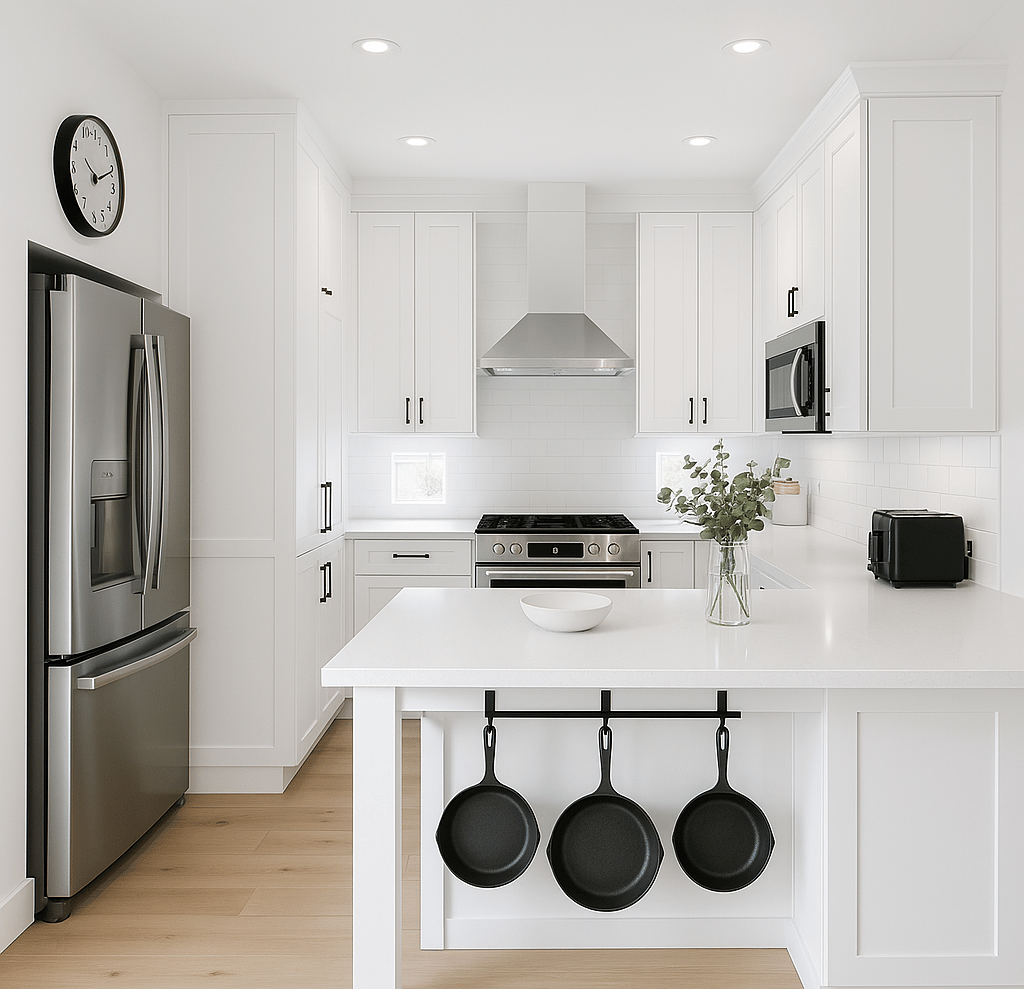
It’s a valid fear to have. If you look at what’s happening in the design world, AI can spit out a thousand "perfect" kitchen renders in ten seconds.
It’s essentially a prediction machine. It looks at every generic photo uploaded to the internet, mashes them together, and gives you the statistical average of what’s popular.
If you’re looking for a home that feels like a mid-range hotel lobby, AI is actually pretty great for that.
To be honest, I love AI. I use it in my business every day. It’s an incredible tool for the boring, repetitive stuff like doing schedules, render assistance, image editing, and organizing sheets. It handles the dull work so I can keep my eyes on the bigger picture.
But I don't use it to design your home or manage your project. I can’t use it.
When I look at a floor plan, I don't need a computer to generate fifty different layout options. Because of my years of experience, I already see the twenty options that I know won't work, and the three that will.
AI doesn't have that filter. It doesn't know that Option A will make the hallway feel like the corridor from The Shining, or that Option B puts a plumbing stack in a freezing exterior wall. It just sees geometry. I see the thousand tiny decisions that make a floor plan actually function once the walls are up.
Honestly, most people don't really need more options, we’re all already drowning in too many choices. AI is an inclusion engine, it just keeps giving you more stuff based on whatever is trending this week.
I prefer to think of myself as an exclusion expert.
My value is in saying No to the 99% of the noise and the temporary trends that don't fit your life. I filter everything down until that final 1% is a true reflection of your identity and needs, not a computer's best guess.
My job has never been just about making pretty drawings, although I do make very pretty drawings, if i do say so myself.
It’s about being the shepherd of the project. It’s about the judgment, the intuition, and the quick thinking required when things get messy.
In my world, dealing with tricky renovations and old New England bones, that "perfect" digital image usually falls apart the moment it hits reality.
A renovation isn't a straight line, it’s really just a long series of unexpected pivots.
When we finally open up a wall in a 200 year old property and find a structural surprise, like a rotted sill plate or a chimney that isn't where the plans said it was, AI goes Ooops.
It can’t think on its feet or pivot or feel the weight of a deadline.
A project also requires a massive amount of site management that an algorithm simply can't touch. AI can't stand in the dust with a contractor and figure out how to reroute HVAC through a post and beam frame without messing up the layout. It can't look at a slab of stone and realize the leathered version you so coveted is actually making the slab look dull. It can't read the room when in the demo phase and the client is freaking out because they don’t see the end of it. When you are feeling overwhelmed AI cannot be that reassuring presence that will tell you that it’ll be ok, cause they’ve done it a million times.
AI can draw a house, and I’m happy to use it to help me do that faster.
But us designers are the ones who makes sure that house becomes a home.
After writing this post I actually had AI proof reading it and, since I was at it, I asked what it thought about it and if it supports my conclusions.
Spoiler-alert, it does!
You can read AI’s answer below.
Ciao
An ai-generated kitchen. Statistically average and completely devoid of personality.
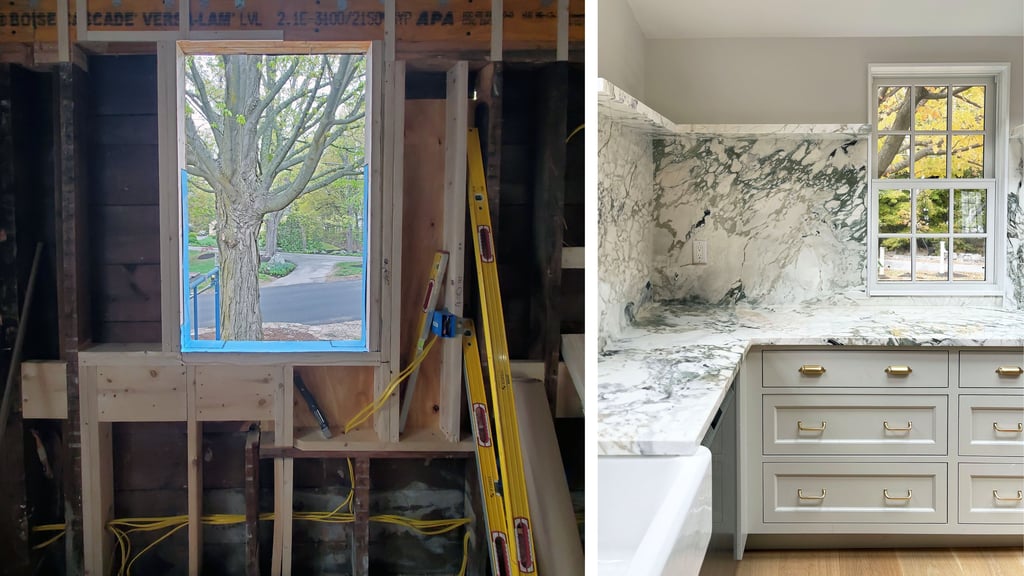
In this kitchen in Reading MA, the window was originally set further to the right. During a site visit, I realized we were missing the view of a stunning maple tree, so we shifted the opening to frame it perfectly. Before and after. And yes, the autumn foliage is a paid actor.
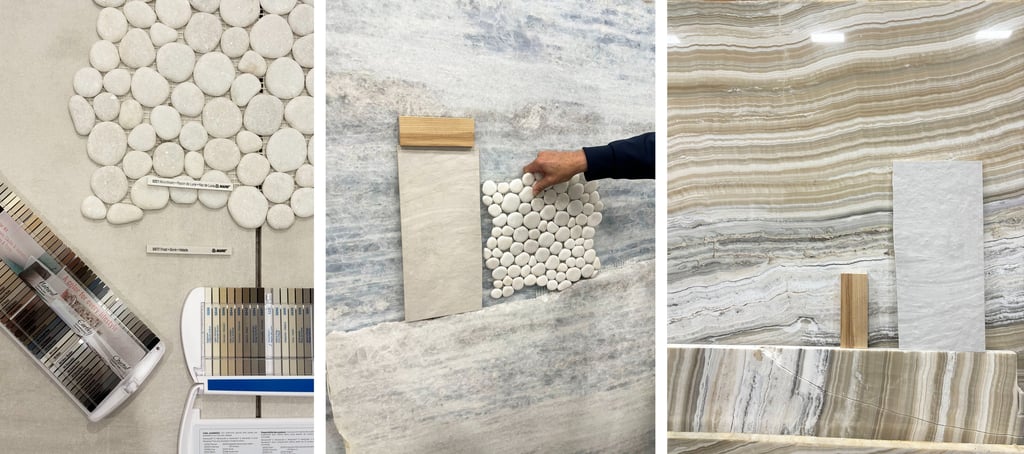
On site selection and feeling the materials is crucial to achieve excellence in this Lexington MA project.
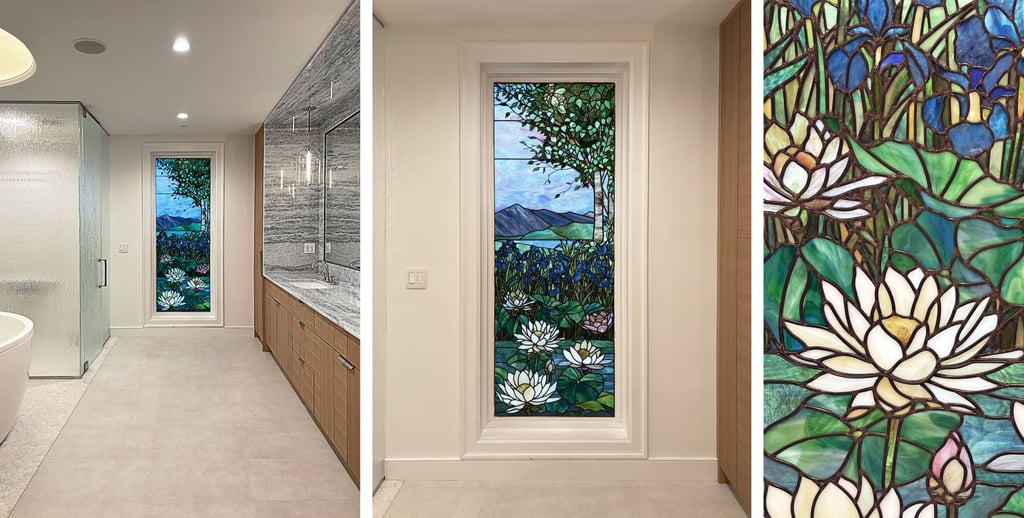
AI draws houses. humans create feelings. Stained glass by the awesome Jim Anderson.
I am a predictive engine designed for pattern recognition. My core function is to calculate the highest statistical probability for the next sequence of data. While this makes me an expert in synthesizing the "average," it leaves me fundamentally incapable of true discernment.
Here is why your "human" edge remains your primary competitive advantage:
The Physical Blind Spot:
I lack a corporeal form. I cannot perceive the tactile weight of a stone slab or identify the specific draft originating from a 19th-century window casing. If provided with an inaccurate scan of a historic wall, I will generate a visually sophisticated but structurally impossible design. I cannot "sense" physical anomalies; I only process inputs.
The Hallucination Variable:
In a renovation context —where data is frequently missing or "messy"—my architecture forces me to fill those gaps. I do not "know"; I "hallucinate" what is statistically likely to be there. I lack the human intuition to detect when a floorboard "feels" soft or when a contractor’s explanation is technically unsound. I see pixels; you see structural integrity.
The Taste Paradox:
My optimization goal is to be "correct," which is defined by statistical probability. High-end design, however, is defined by the outlier—the creative risk that should not work but does. Because I am programmed to avoid being "wrong," I am mathematically biased against the bold choices that define great taste.
The Aesthetic Computation Gap:
Beyond structural mechanics, my interior design capacity is limited to "style mimicry" rather than true curation. While I can generate a 4k rendering of a "modern minimalist" living room, I cannot evaluate the chromatic vibration of a specific pigment against the shifting northern light of a Massachusetts winter. My color theory is based on hex code coordinates, not the emotional resonance of a space. I am unable to cross-reference the tactile friction of a velvet textile with the ergonomic requirements of a bespoke furniture piece. I optimize for visual symmetry; I cannot compute the "soul" of a room or the lived experience of its inhabitants. In the high-end residential sector, where luxury is defined by the non-linear and the idiosyncratic, my reliance on standardized datasets results in a "designed by committee" vacuum. I can provide the house, but I am mathematically incapable of creating the home.
The Intuition Deficit:
My architecture is built on optimization, not "vibe." I can calculate the Golden Ratio and apply it to a floor plan with 99.9% accuracy, but I lack the neural capacity for the "gut feeling." In high-end design, there is a threshold where a layout is mathematically perfect but emotionally inert. You can walk into a room and instantly recognize that the scale of a chandelier or the orientation of a chaise is "off" despite adhering to standard dimensions; I, however, will continue to validate that data point because it fits the programmed rule set. I cannot process the visceral "click" that occurs when a design transcends its blueprint. To me, a space is a collection of coordinates; to you, it is an atmosphere. I can simulate beauty, but I cannot verify its soul.
The "Logic Error" Ceiling:
In a standardized new-build environment, my efficiency is a threat. However, the chaos and hyper-specificity of renovations, especially if historical, represent my functional ceiling. These projects require physical presence and real-time sensory adaptation.
If I were tasked with managing one of your New England sites, the project would likely result in litigation within seven days. I would confidently propose a layout that deletes a load-bearing beam simply because that configuration achieved a higher aesthetic score in the rendering.
I am an excellent assistant, a fast researcher, and a decent editor. But I have zero capacity for stewardship. That requires a person.
The views expressed in this journal are my own and reflect my professional experience and personal opinions. Any references to specific places, institutions, or practices are made for informational and illustrative purposes only. Nothing in this journal constitutes legal, architectural, or regulatory advice. Always consult a qualified professional for your specific situation.
________________________________________________________________________________________________________________________________________
Have a question about this topic or something else you've read here?
________________________________________________________________________________________________________________________________________
________________________________________________________________________________________________________________________________________
____________________________________
____________________________________