Why You Shouldn't Gut a Historic Home (Even If Nobody Is Stopping You)
Historic home renovation without gutting: what original materials are actually worth, how to decide what stays, and why the default answer is almost always wrong.
HISTORIC NEW ENGLAND
Erica Fossati
13 min read
If you read my post on Certificates of Appropriateness, you already know that Massachusetts historical commissions have jurisdiction over exteriors only. What happens inside a non-certified historic home is entirely your business. No regulatory body, no approval process, no one standing between you and a dumpster full of original millwork.
This is, to put it plainly, a problem.
An extraordinary number of homes with genuine historical character get gutted every year, not because gutting was necessary, not because the original fabric was unsalvageable, but because it was easier. Because the contractor bid it that way. Because the new owners wanted everything fresh and couldn't see past the layers of bad decisions made by previous owners to what was actually underneath. I am not here to tell you what to do with your house. I am here to make sure that if you gut it, you do so with full awareness of what you are throwing away and why, so that the decision is yours and not just the path of least resistance.
The Regulatory Gap, and What Happens When You Cross the Atlantic
In the United States, if your property is not individually listed on the National Register of Historic Places and does not sit within a certified local historic district, no one has any legal authority over what you do to its interior. You can remove original wide plank floors, demolish plaster walls, strip built-in cabinetry, replace hand-forged hardware with something from a big box store. All of it, entirely legal, entirely unreviewable, entirely permanent.
In Italy the situation is almost the mirror opposite. The Soprintendenza Archeologia, Belle Arti e Paesaggio oversees essentially everything built before the Twenties with the thoroughness of an institution that has been doing this since the Renaissance and has no particular interest in being rushed. The problem with the Italian system is not the rigor, it's what happens when the rigor is applied without judgment, when the regulatory framework substitutes for thinking rather than informing it.
I will give you an example. In my third year at the Politecnico di Milano, in the Laboratorio di Progettazione 3, the last major design studio before the bachelor's degree, our project was the renovation of the cellars of the Museo Diocesano, specifically a basement used to store fondi oro: medieval and Byzantine panel paintings with gold leaf grounds, the kind of objects that make you lower your voice without being asked. We were there as students, working under a professor who was not the type to make things simple when they were actually complicated.
In one of the cellars there was a post. Not a beam in any structural sense, just a wooden post protruding from the wall at approximately head height, directly in the middle of the circulation path. It served no purpose in the current configuration, it was literally in the way of everything. My professor, who was not a man easily appalled, was appalled.
The Soprintendenza when issuing its Vincolo on the building (literally translate to Constraint, it's the Soprintendenza's formal declaration of protection, once placed on an element, any intervention requires their authorization, and removal without it is a criminal offense) had ruled that post a historical artifact, not to be touched.
The reason? During the Austrian occupation of northern Italy in the early nineteenth century, Risorgimento resistance fighters used that specific cellar as a meeting place, and they hung their salami from that specific post. We literally had to design around that thang.
I mean no disrespect to the Risorgimento or to salami. The history is real and the courage of those men was real. But it was my professor's argument that stayed with me, made in that cellar in front of that post, that a photograph and a well-placed interpretive plaque honors a story just as faithfully as an obstacle that people hit their heads on for eternity. Preservation without criteria is not preservation. It is an inability to make decisions dressed up in institutional authority. And the question of what criteria to use, of what is actually worth keeping and why, is the question that has followed me through every renovation since.
The question is never only whether something is old. The question is what you lose by keeping it, what you lose by removing it, and whether the story it tells is worth telling in exactly that form. That judgment is the thing. In the United States we have almost none of it institutionally, which is why historic interiors get gutted by default. In Italy they have so much of it that it occasionally becomes its own kind of obstacle. The answer, as with most things, lives somewhere in the middle and requires an actual human being with actual knowledge to find it.
The Problem of Dating American Historic Interiors
Before you can decide what to keep, you have to establish what is actually original, which in an American historic home is considerably more complicated than it sounds.
In Europe, architectural eras are visually distinct in ways that make attribution relatively straightforward. Romanesque does not look like Gothic. Gothic does not look like Baroque. The styles are separated by centuries and characterized by a formal consistency that reflects both the slow pace of change and a kind of stylistic purity that was largely cultural. You will not confuse a building in Florence with one built two hundred years later, the materials alone will tell you.
In the United States, and particularly in New England, this clarity largely does not exist. American architectural history is substantially a history of revivals: Greek Revival, Gothic Revival, Italianate, Queen Anne, Colonial Revival, Tudor Revival. Styles that were invented elsewhere and centuries earlier, reinterpreted here in compressed sequence, often layered on top of each other as tastes changed and budgets allowed. A house built in 1840 may have Greek Revival details that were fashionable at the time, Victorian millwork added in the 1880s, Colonial Revival hardware installed in the 1920s, and a bathroom tiled in the 1980s by someone who should have known better. All of it accumulated in the same walls.
This means that even an experienced eye cannot always determine with certainty what is original to a structure and what was added later. Short of dendrochronology or paint analysis, which exist and are occasionally warranted but are not standard practice in a residential renovation, you are working with sensibility, pattern recognition, and informed inference.
What sensibility gives you is not certainty. It gives you a framework for the more important question: does this element belong? Is it native to the house, regardless of whether it was there from day one? Is it worth preserving on its own terms? A piece of millwork that was added thirty years after construction but was done thoughtfully and has been part of the building's character ever since is worth a different conversation than a dropped ceiling installed in 1972 that is hiding something extraordinary.
The goal is not archaeological purity. These are homes, and they have to function as homes. The goal is judgment, applied carefully, to each element on its own merits.
The Pros, the Cons, and the Things Worth Knowing
There are genuine arguments on both sides of this, and I would rather give them to you honestly than pretend the preservation position is without cost.
The cons are real.
The upkeep is real and it is expensive. Maintaining a historic home is more expensive and more complicated than maintaining a contemporary one. When something breaks, and something will always break, finding a skilled trade who knows how to repair lime plaster, reglaze a historic window, or source matching hardware for a hundred-year-old door is not the same as calling a general contractor. The pool of people who can do this work well is smaller than it used to be, and they are in demand. If you gut a historic interior and replace it with contemporary finishes, your maintenance universe expands considerably. That is a legitimate tradeoff and it is worth naming.
The structural realities of renovation also complicate preservation. When you open walls to update mechanical and electrical systems, and in most historic homes you will need to, the lime plaster often cannot survive intact. This is not necessarily a reason to gut everything proactively, but it does mean that some loss is unavoidable in the course of a serious renovation, and pretending otherwise is not useful.
The pros, however, extend well beyond the aesthetic.
People operate under a persistent assumption that newer is better, that materials improve over time, that what was done a hundred and fifty years ago was a primitive approximation of what can be done today. In residential construction, this is frequently wrong.
The original materials are better than you think. Old growth timber, milled from trees that were two hundred years old when they were cut, has a grain density and dimensional stability that plantation lumber from a thirty-year-old tree cannot replicate. It does not warp, it does not move seasonally the way newer wood does. Original wide plank floors that are still flat and tight after a hundred and fifty years are not lucky, they are the expected performance of a superior material.
Lime plaster, the standard wall finish in historic New England homes, is hygroscopic, meaning it absorbs and releases moisture in response to changes in humidity. This regulates the interior environment in a way that drywall, which replaced it almost universally in the mid-twentieth century, simply does not. Lime plaster also has a depth and variation in the way it takes light that no flat-painted surface can approximate, and it is self-healing to a degree: small cracks can be repaired seamlessly by a skilled plasterer in a way that drywall patches, which always show, cannot match.
Original wood cabinetry and millwork was designed with cleanability in mind, partly from necessity, because these were working households, and partly because the craftsmen who made it understood the material. Dark stained wood does not show dirt. It does not show chipping in the way a painted cabinet will. When it wears, it wears gracefully. When a white painted cabinet chips, it looks like a white painted cabinet that has been chipped.
None of this means that new materials are never appropriate or that original elements should be preserved at any cost. It means the calculus is not as simple as new equals better, and anyone telling you otherwise is either not paying attention or has a financial interest in the demolition.
You know what you are buying. The other thing that original materials have is that they have already been tested. When you purchase an older home, the problems it has are the problems it is showing you. The foundation has settled as far as it is going to settle. The moisture issues have manifested. The structural quirks are visible. When you purchase a developer-built new construction, you are the first person to live there, and you will spend the first several years discovering what it does under actual conditions. This is not a theoretical risk. It is the standard experience of buying new construction, particularly when the developer's primary incentive was speed and margin rather than quality.
Character sells. I have had enough conversations with real estate agents to say this with confidence: the safe choices do not outperform the considered ones. White counters, neutral everything, cookie-cutter finishes that could belong to any house anywhere do not command premiums. What commands premiums is specificity, identity, the feeling that a house is irreplaceable. Deck Houses, the prefabricated modernist structures built by the Acorn company in the mid-twentieth century, consistently sell above asking in Massachusetts because they have an unmistakable character and a build quality that new construction cannot touch. The same principle applies to a well-preserved Victorian interior or a Federal-period room with original plaster details and wide plank floors. You are not decorating to appeal to everyone. You are preserving something that cannot be reproduced and pricing it accordingly.
Older homes were designed for humans. There is also an argument about scale and human proportion that I think about often. New construction, particularly developer-built residential construction, has drifted toward dimensions that feel theatrical rather than livable. Rooms that are too large to furnish sensibly, ceilings that are impressive on a listing sheet and acoustically exhausting to live under, open plans that sacrifice privacy and acoustic separation for visual drama. Historic homes were built to a human scale because they were built by people who lived in them, for people who would live in them, without the intermediary of a marketing strategy. The rooms are the right size and the proportions make sense. This is not nostalgia, it is ergonomics. If thirteen years ago someone had told me my biggest problem in this country would be rooms that are too large, I would have laughed so hard. Cry in Italian.
Next generations. And finally: every generation that chooses to preserve rather than gut is making an argument to the next one that these things matter. There is no regulatory body requiring this in most American historic homes. Which means the only thing standing between an original interior and a dumpster is the judgment and values of the person who owns it. That is a significant amount of responsibility, and most people do not think of it that way until after the decisions have been made. Younger buyers are increasingly drawn to homes with genuine character and material quality, and there is a growing awareness, particularly among millennials and Gen Z, that what gets gutted now is gone permanently. The market is reflecting this, slowly. But the cultural shift is still outpacing the institutional support for it, which is precisely why individual choices matter so much right now.
What Gutting Actually Costs
The assumption that gutting is cheaper deserves some scrutiny, because it is often wrong in ways that are not immediately visible.
Disposal of original materials costs money. New materials cost money. The labor to install new finishes in a structure that was built to different tolerances than contemporary construction costs money, often more than people anticipate. And then there is the problem that follows almost every gut renovation of a historic interior: it doesn't look quite right, and so there is more spending to fix it, and it still doesn't look quite right, because what you are trying to approximate no longer exists in the building and cannot be fully recreated from contemporary materials.
Insulation, which is often cited as the primary reason walls need to come down, does not actually require gutting. Dense-pack cellulose or fiberglass can be blown into stud bays through small holes drilled either from the exterior between clapboards or through the plaster from the interior, then patched. Continuous rigid insulation can be added at the exterior over the sheathing before re-cladding, leaving the interior fabric entirely undisturbed. These approaches require more care and more skilled labor than a full gut, which is the real reason they are less common. Not because they are impossible.
The decision to gut should be a decision, not a default. That is the entire argument.
What This Means in Practice
A friend of mine owns a Tudor Revival in Lancaster, Massachusetts, a town with more significant historic residential stock than most people realize. The previous owner had painted over the original woodwork in solid green, installed glass block in a location that need not be specified, and made several other decisions that I will not enumerate here. He was a man dealt a difficult hand in life, and his choices in that house reflected circumstances more than taste. I mention this not to be unkind but because it is a useful reminder that historic homes accumulate the decisions of everyone who ever lived in them, made under conditions we rarely know anything about. We must not judge to harshly on that.
When my friend had the woodwork stripped, the stripping revealed sun damage: areas where the wood had been exposed to light before the paint went on, changing color unevenly across the surface. This is, in retrospect, exactly why the paint was applied in the first place. The stripping also made clear why hand-stripping intricate historic woodwork, while sometimes the only option, produces results that are visible on close inspection in ways that laser cleaning, now available from specialized preservation contractors, does not. Laser cleaning removes paint layer by layer with a precision that mechanical and chemical stripping cannot match, recovering carved details and profiles that would be damaged or lost by any other method.
The solution to the sun damage was a slightly darker stain, uniform enough to read as consistent, transparent enough to show the grain. The wood is now the thing it was always supposed to be, the green paint is gone, and the glass block is a memory.
Whatever the problem, there is always a smart solution for it that doesn't necessary entail a flamethrower.
If you are buying or currently own a historic home that is not individually certified, no one is going to make you preserve anything. The choices are entirely yours.
What I am asking is that you make them consciously.
Walk through the house before demolition begins. Bring someone who knows what they are looking at. Understand what is original, or as close to original as can be determined, and what was added later. Understand what the later additions are worth on their own terms. Understand what the original materials are made of and how they perform, because the answer is often more impressive than you expect.
Then decide. If the mechanical and electrical update requires opening the walls and the plaster cannot survive it, that is a real constraint and it calls for a real decision, not a guilty one. If the layout genuinely does not work for contemporary life and changes are necessary, make them thoughtfully and with full knowledge of what is being altered. These are homes and they have to function as homes.
But if the reason the walls are coming down is that it is easier to start from scratch, or that the contractor bid it that way, or that new feels safer than old, those are not reasons. Those are defaults. And defaults, in a building that has been standing for a hundred and fifty years, are a very particular kind of waste.
I will add a personal note here, because I think it is relevant.
My own house is not historic by any definition. It is a young Colonial, perfectly pleasant, chosen partly because my engineer husband, who has extremely high standards for how things function, would have a nervous breakdown managing the upkeep of an actual historic property. I would have loved the historic. We compromised on functional.
The kitchen is twenty years old and made of cherry, with an intricately bold granite slab that I have no intention of touching. The oven is original to the house. I am waiting for it to break so I have a legitimate reason to modify the cabinet around it, which means it will almost certainly outlive me and become the oldest operational oven in Massachusetts. When the time comes, I will strip the wood back to its natural color to make it a bit lighter, that's it. I will certainly not be replacing those panels with MDF. My furniture-making ancestors would rise from the tomb.
The point is that this is not a philosophy reserved for certified historic properties. It is just a way of looking at what you have, and it is an argument I hold dear. Partly professional conviction, partly something more personal: my grandparents lived through actual invasions, and people who have had things taken from them don't waste good solid things. You use what you have, you maintain what works, and you don't throw away a cherry kitchen because a magazine told you the trend moved on. I will write separately about normalizing adaptive reuse, because it deserves its own post and because I have a lot to say about it.
There is, in fairness, reason for optimism. The clients I am seeing now are more educated, more curious, and more willing to be bold than they were a decade ago. They arrive having done research, having looked at precedents, having formed actual opinions about what they want to preserve and why. They are smart enough to know what they don't know, which is the most useful quality a client can have. The overwhelming majority of historic interiors still get gutted, and that is not changing overnight. But the conversation is shifting, one house at a time, and the people choosing to engage seriously with what they have rather than erasing it are quietly building an argument that compounds over time. Education is slow, good houses are patient, and occasionally the two find each other.
If you want to be part of that change, and you have a house worth doing it right, let's talk.
Ciao.

The vincolo was real. The salami were real. The AI just connected the dots.
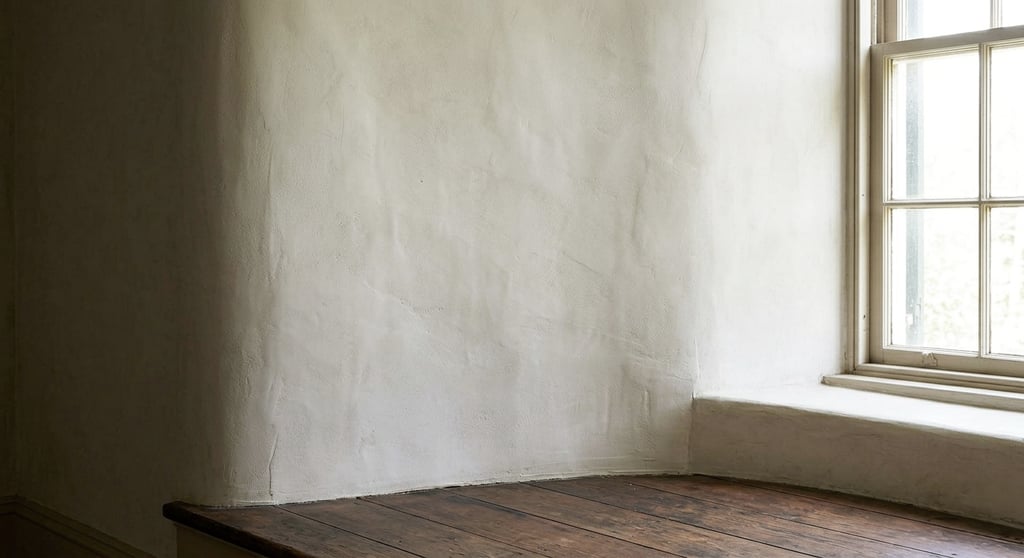
A lime plaster closeup, I personally love the depth it brings to a surface.
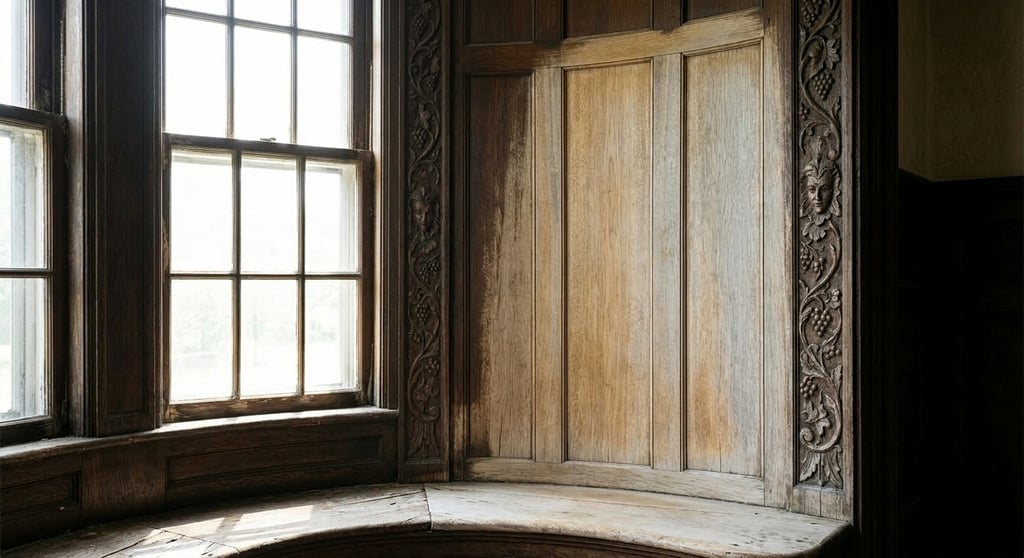
Sun bleached panels in a Tudor Revival in Lancaster, MA, exposed after paint was stripped.
A very satisfying laser cleaning video, this technology can be used on multiple surfaces such as metal, wood and stone.
The views expressed in this journal are my own and reflect my professional experience and personal opinions. Any references to specific places, institutions, or practices are made for informational and illustrative purposes only. Nothing in this journal constitutes legal, architectural, or regulatory advice. Always consult a qualified professional for your specific situation.

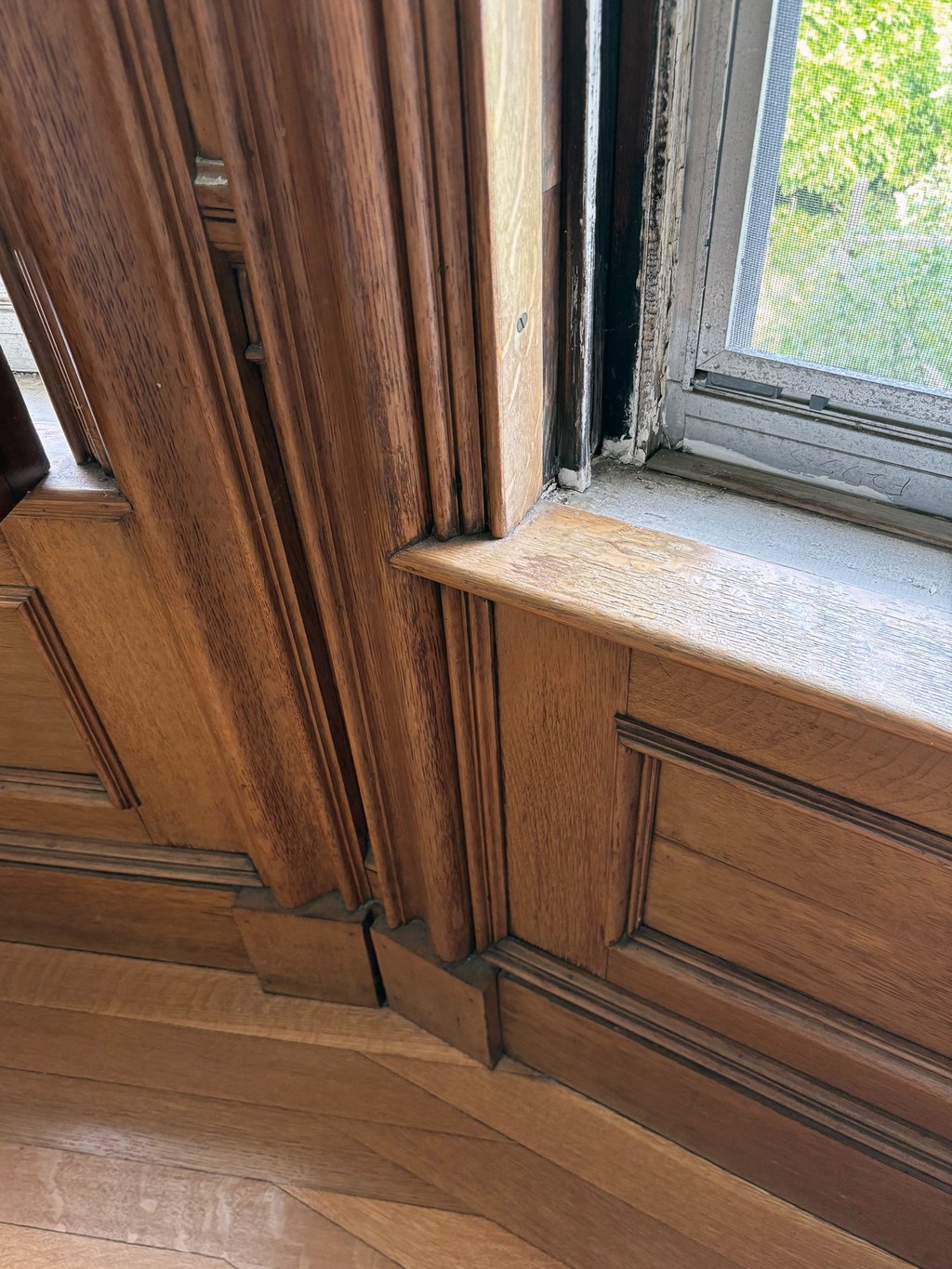
Beautiful bow window paneling detail in a Second Empire Italianate in Harvard, MA.
________________________________________________________________________________________________________________________________________
Have a question about this topic or something else you've read here?
________________________________________________________________________________________________________________________________________
________________________________________________________________________________________________________________________________________
____________________________________
____________________________________