Certificate of Appropriateness in Massachusetts: Ten Mistakes That Will Get You Nowhere
What Massachusetts historic district commissions actually want, and why some Certificate of Appropriateness applications get it wrong in New England.
Erica Fossati
10 min read
If you made it through my last post on researching a historic property, you already know that getting your hands on solid documentation before touching a single thing is not optional, it is the foundation of everything that comes next. The next step, if your property falls under historical jurisdiction, is applying for a Certificate of Appropriateness from your local historical commission.
I have worked with historical commissions across Massachusetts, including Cambridge, Concord, Arlington and Harvard. I will tell you what I have learned, and I will also tell you why a lot of applications do not go the way their authors hoped.
There is no shortage of generic guidance online about what to do when you apply for a Certificate of Appropriateness. Use appropriate materials. Be respectful of the historic character. Consult the Secretary of the Interior's Standards. All correct, all easily googleable, and frankly all a little boring. This post is about the don'ts, because that is where the interesting stuff lives and where most applications fall apart.
A quick note on perspective. I trained as an architect in Italy, where the regulatory body overseeing historic properties is the Soprintendenza Archeologia, Belle Arti e Paesaggio, a national institution with jurisdiction over essentially everything built before your great-grandmother was born and the disposition of a medieval inquisitor. After dealing with them in Milan and Florence, a Massachusetts historical commission feels, I will be honest with you, fairly manageable and quite adorable. The principles are the same. The paperwork is lighter.
What Is a Historical Commission and Why Does It Have Any Say Over Your House
In Massachusetts, local historic districts are established under Massachusetts General Law Chapter 40C, known as the Historic Districts Act, first enacted in 1960. A local historic district is established by a two-thirds majority vote of the city council or town meeting, and once it exists, a Historic District Commission is appointed to review proposed changes to exterior architectural features visible from a public way.
Here is the part that surprises a lot of people: your house does not need to be a certified historic landmark for these rules to apply to you. If your property sits within a local historic district, you are subject to the commission's review regardless of whether your specific building has any individual historic designation. You could own a perfectly unremarkable house built in 1987 in the middle of a district established around its 19th-century neighbors, and the commission still has jurisdiction over your exterior.
The key word there is exterior. If your property is in a historic district but is not itself an individually certified historic structure, the commission's authority stops at the front door. Paint your living room whatever color you want. Gut the kitchen. The commission does not care, what it cares about is what the building looks like from the street.
This is, on its own, a heartbreaking subject. An extraordinary number of houses with significant historical interior details get gutted every year, either because the client wants everything new or because mindlessly stripping it out is easier to design and cheaper than restoring it. Original millwork, wide plank floors, plaster details, built-in cabinetry, hardware that has been in place for a hundred and fifty years. Gone, because nobody was legally required to think twice about it. I will write about this separately, because it deserves more than a parenthetical, but I want to name it here because it is real and it happens constantly.
The situation becomes considerably more complicated if your property is individually listed on the National Register of Historic Places. That opens up a different and more involved set of requirements, including potential review under the Secretary of the Interior's Standards for Rehabilitation, which deserves its own post entirely. I will get there. This is not something that catches people by surprise, by the way. When you purchase a property that is individually listed in the National Register, you'll likely have to sign a Preservation Restriction Agreement at closing. It is a legal document, you did not accidentally become the owner of a certified historic structure and fail to notice.
For less complex situations, the first thing to establish before you do anything else is whether your property falls within a local historic district. Check your town's zoning map, call the building department, or look up your property on MACRIS. If you are in a district, you need a Certificate of Appropriateness before you can make any changes to the exterior. No permit will be issued without it.
The Ten Deadly Sins of a Certificate of Appropriateness Application
Not quite capital sins in the theological sense, but in the context of a historic district hearing, the offenders will most likely go to Hades.
1. Not understanding why the commission exists. The commission is not a taste arbiter and it is not a bureaucratic obstacle, it is a neighborhood consistency mechanism. Approach it accordingly. Showing up to a hearing with a personal narrative instead of a design argument is not a strategy, it is a waste of everyone's time including yours. The commission does not care that your grandmother really loved hot pink and you want to pay homage to her with your shingles. I say this without judgment.
2. Not looking at the neighborhood. I have seen applications that seemed to have been designed in complete isolation from their context. If your proposal could have been dropped from the sky onto any street in any city and nobody would notice, or if it looks like it's been designed by 3 different people, that is a problem. You don't want your design to looks like it woke up drunk in another continent. That's poor form, literally.
3. Going ultra-modern and expecting a free pass. There is a persistent belief that a radically contemporary design will sail through a commission because it makes no attempt to imitate the historic fabric and therefore cannot be accused of doing it badly. This reasoning is wrong. You can absolutely go contemporary, but a contemporary addition or new building in a historic district still has to account for the materials, scale, and massing of what surrounds it. A glass and steel box dropped between two 19th-century clapboard houses with no acknowledgment of their proportions or rhythm is not bold, it's lazy. I will write a separate post about contemporary additions done well, because there are genuinely good examples and they are worth studying.
4. Improper massing. They say size isn't everything (pun intended). In historic districts, they are wrong. This has become particularly relevant in Cambridge since the city passed its landmark multifamily upzoning in February 2025, allowing buildings of up to four stories by right citywide, with six stories possible on larger lots with affordable units included. What it does not do is exempt anyone in a historic district from demonstrating that their proposed mass is appropriate to its context. You cannot take a lot that previously held a modest two-story house on a street of modest two-story houses and propose a six-story building as though the neighbors do not exist. The result looks parasitic and the commission will see it for what it is, so will everyone else.
5. Being stingy with the drawings. A thin application set signals one of two things: that you have not thought the project through, or that you are hoping the commission will not ask too many questions. Neither is a good look. Give them elevations, sections, material callouts, pictures taken from different angles from the street, spec sheets for the windows and context drawings that show how the proposal sits within the streetscape. We have the technology to produce visual simulations that are genuinely useful. Use them.
6. Being dishonest with the simulations. The flip side of the above. Commissions are not full of idiots. A rendering that has been lit, filtered, and composited to make a mediocre design look like something it will never actually be is not going to fool anyone who has been sitting on that board for ten years. Beyond the practical problem that it does not work, there is an ethical one: you are asking the commission to approve something based on a misrepresentation. Your simulation should be your honest best approximation of what the finished building will actually look like. That is the standard.
7. Not doing your homework. Submit a property description. Submit a project description. Show that you have researched the building and the neighborhood. Include a source list. Reference the MACRIS form. Cite the photographs you found. Name the materials you are proposing and explain why you chose them. A well-documented application tells the commission that the person who prepared it understands what they are doing and has taken the process seriously. It also gives the commission very little to push back on, because you have already answered the questions they were going to ask.
8. Not asking for a preliminary opinion before you submit. In Italy this is standard practice and it has a name: Parere Preventivo, a preliminary opinion requested from the regulatory body before a formal submission is made. I have done it with the Soprintendenza, with building departments, and I do it here too. It's not poking a sleeping dog, it's smart.
Most historical commissions are willing to have an informal conversation with you before you submit a formal application. Go to them with a concept, basic drawings, and a clear sense of what you are proposing. Not a sketch on a napkin and two percent of an idea, but enough that the conversation is substantive. Ask what they are likely to respond well to, if there are precedents in the district that are relevant to your project, if there is anything they would flag immediately.
You learn where the sensitivities are before you have invested in a full drawing set. You give the commission members a chance to feel involved in the process rather than surprised by it. And when you do submit formally, you are not walking in cold, you are walking in having already had the conversation, which changes the dynamic entirely.
9. Using greenery to hide a bad design. Not so good projects are almost always dressed up with an unusual amount of landscaping. Trees in front of every window, shrubs climbing the facade, greenery strategically placed wherever the design is weakest. If I were sitting on a commission and someone presented a proposal for a row house in Back Bay where the only thing visible in the front elevation rendering was trees, I would know immediately that something was off. Landscaping is part of a proposal, not a curtain. The commission will see right through it, and so will everyone else in that room.
10. Presenting a half-baked project. This should go without saying, but you would be surprised.
Do not go to a historic district hearing with placeholder decisions, not as a designer, not as an owner. As a designer, you look incompetent. As an owner, you look like you couldn't be bothered. Either way you are wasting the commission's time, which is a bad way to start a relationship with the people who are about to decide whether your project moves forward. You go when you are ready, not before. Imagine if someone on the commission asks you a specific question about a material, a window profile, a roofline detail and your answer is that it was really just a placeholder.
C'est directement à la poubelle.
What the Commission Actually Cares About, and Who They Are
Before you prepare a single drawing, understand what you are submitting to. A historical commission exists to protect the visual coherence of a neighborhood or district, that's it. The commission wants to know one thing: does your proposal respect the character of the district? That means materials, massing, scale, fenestration, and how your building reads in relation to its neighbors. Everything else is secondary.
It also helps to understand who is actually sitting across the table from you. Historical commission members are mostly volunteers. Erudite, locally invested people who care about their town, love its history, and have given up their evenings to protect it. They are not there to say no, they are there to say yes and to be amazed by things that are done right. Show up with thorough research, a clear argument, and honest drawings, and you will find them genuinely interested and engaged. They are not your adversaries, treat them like the knowledgeable, passionate people they are and they will generally respond in kind.
The prettiest towns in the world have a common thread when it comes to materials and typology. Siena is built almost entirely in brick, in a consistent Gothic vocabulary that spans the 13th to 15th centuries. Assisi is all Subasio limestone, locally known as pietra rosa di Assisi, Romanesque and early Gothic throughout. That consistency is not an accident and it is not a limitation. It is what makes those places look the way they do. The same logic applies in New England. Before you propose anything, walk the neighborhood. What are the dominant materials? What are the typical setbacks? What is the scale of the buildings around yours? Your proposal should be able to answer for all of those things before it gets in front of a commission.
What a Good Application Looks Like
A good application set tells a coherent story. It starts with what exists, describes what is proposed, demonstrates that the proposal is grounded in an understanding of the property and its context, and presents the information clearly enough that a commission member who has never seen the building can follow the argument.
The MACRIS database property card, the deed description, the building permit record, the photographs from the historical society: all of that belongs in the application package. It shows your work and it builds your case.
After dealing with the Soprintendenza in Milan and Florence, where the bar for documentation is approximately the height of the Duomo and the margin for error is approximately zero, I have a fairly high tolerance for thorough preparation and a fairly low tolerance for applications that expect a commission to take things on faith. Do the work, submit the evidence, make it easy for the commission to say yes.
If you are still here it may mean that you have a property in a historic district and you are trying to figure out where to start. If that's the case, you know where to find me.
Ciao.
NOTE: David Silverman, FAIA, pointed out that the meetings of the historic commission are public and you can go to hear what they are concerned about on other projects, it's a free education that can go a long way to seeking approval for your clients. I actually have a little cheat for that, I find online the meeting minutes, as they are public record, and ask AI to summarize them for me. It's hard to be on top on everything and be constantly informed. It takes a lot of time to go to meetings, they can last hours and with my kids' after school activities I basically never have the time. You can look up David's work here, he's a very cool guy, a devoted scholar of The Clash, and my former neighbor in Augusta Arlingtonia, otherwise known as Arlington, MA
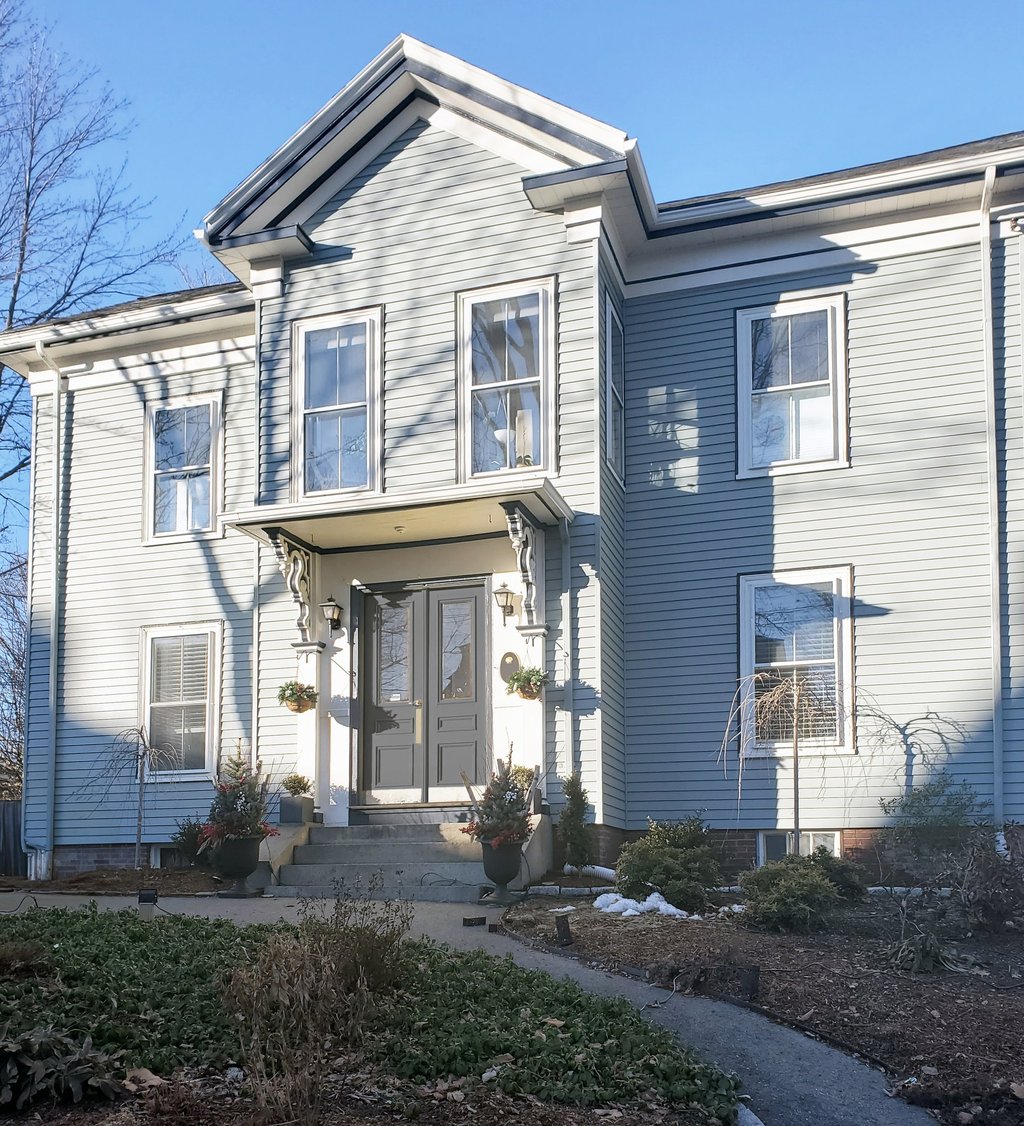
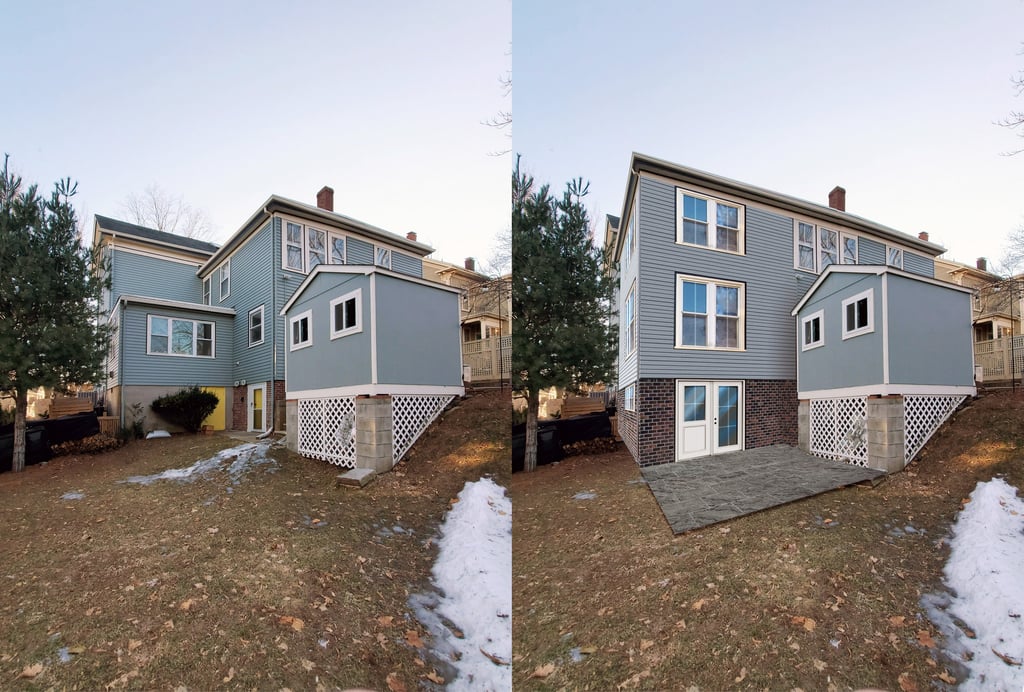
A pretty Italianate in Arlington, within a local historic district. The first question with any addition: what is visible from the public way.
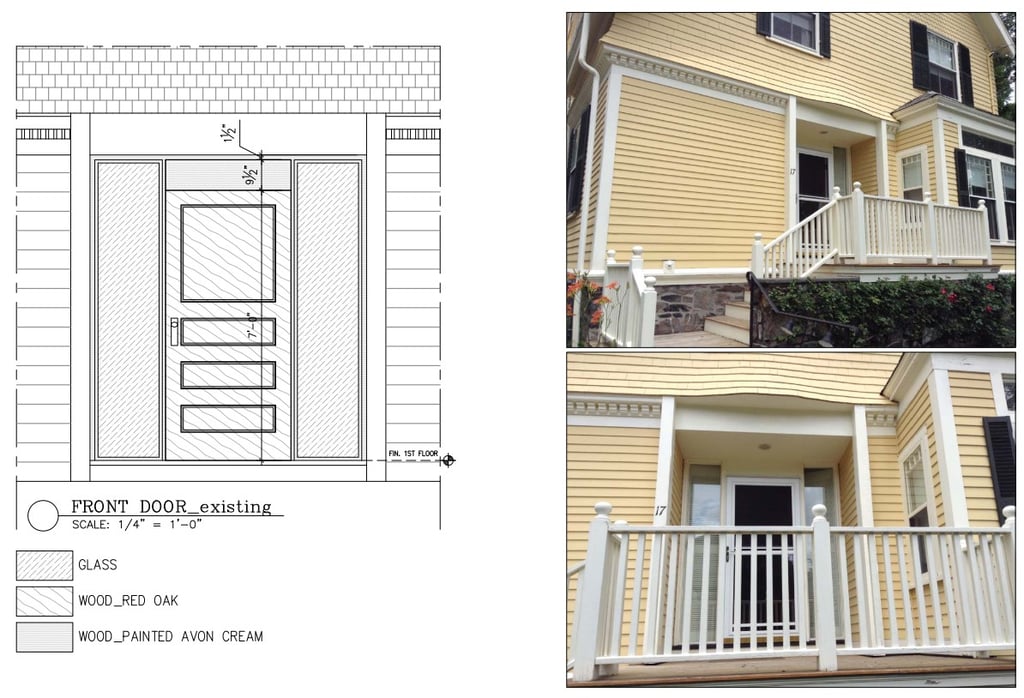
A Victorian home, this time in Cambridge, even for a detail as tiny as this flared eave I still documented the change. This is how it looked.
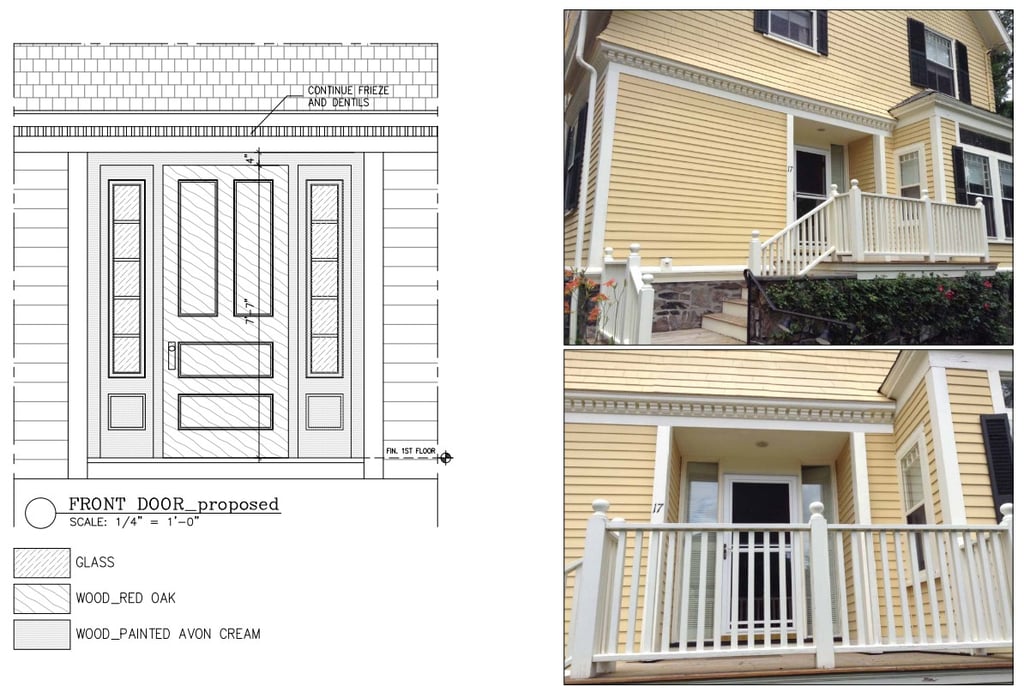
And this is the proposed design. The goal was to create an uninterrupted decorative frieze board.
Spoiler: the addition was not visible from the street. I made the simulation anyway. When in doubt, show your work.
DISCLAIMER: this post reflects my professional experience and is intended as a general resource, not legal or regulatory advice, always consult your local commission directly,
Have a question about this topic or something else you've read here?
________________________________________________________________________________________________________________________________________
________________________________________________________________________________________________________________________________________
____________________________________
____________________________________